
Air conditioning and heating only, since 2019. No plumbing. No electrical. No solar. The parts this valley destroys ride on the truck, not on back order.
SOURCES WE CITE · LAS VEGAS VALLEY
Las Vegas AC Repair Resources: Where Every Number Comes From
Every number on our Las Vegas AC repair pages comes from an official source, linked below. This page links the weather office, health agencies, regulators and building departments whose data shapes how we work. We've been serving Las Vegas since 2019, and we'd rather show our work than ask you to just trust us. No guesswork. No made-up numbers.
Sources are grouped by the question they answer. Each card says what we cite, why it matters to the job, and links straight to the official page.
Licensed & Insured
Serving Since 2019
Same-Day Service
Flat Rate in Writing
HEAT AND HEALTH
Heat and Health: Official Las Vegas and Federal Sources
Every heat number on our emergency AC repair in Las Vegas page traces to one of these four sources.
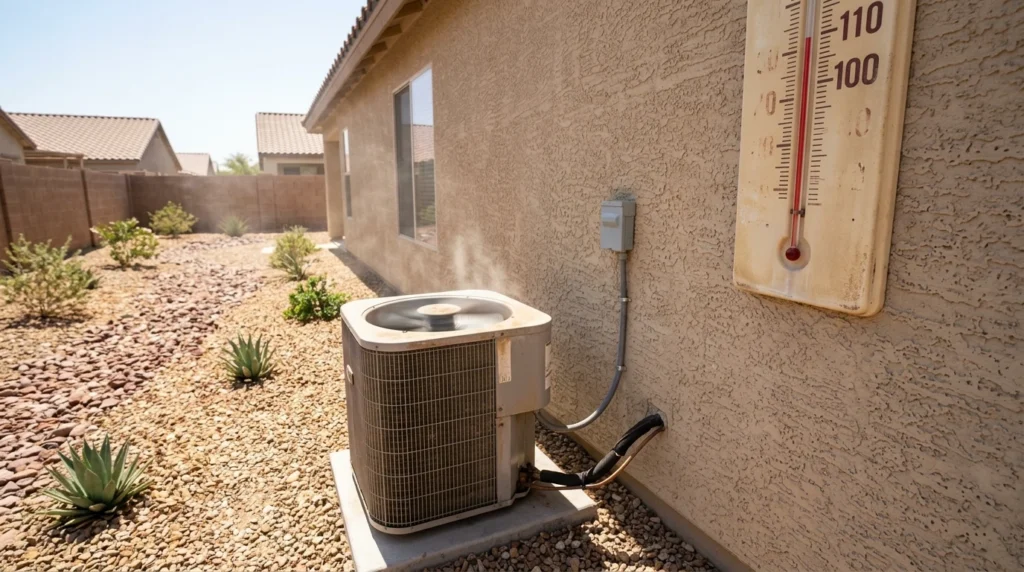
National Weather Service, Las Vegas
This is the federal forecast office for Southern Nevada, and it keeps the official records for Harry Reid International Airport. It logged the all-time Las Vegas high of 120°F on July 7, 2024. Its records show summer 2026 as the second hottest on record, at an average of 94.7°F, with 23 days at 110°F or hotter. July 2026 also set a record of six nights in a row that never dropped below 90°F. That's why we treat a dead AC in July as an emergency, not a chore.
Southern Nevada Health District
The health district tracks heat deaths and heat-related ER visits for Clark County, and it publishes a full report every year. The 2025 report breaks them down by month, by age and by where people were found. The pattern is plain: harm climbs fast once daily highs pass 110°F. We use it to decide which calls jump the line, like a home with an elderly parent or a new baby.
Clark County Office of the Coroner
The coroner looks into every heat-involved death in the county and releases running counts through the summer. As of late September 2026, it had counted 260 heat-involved deaths for the year. We cite that number once, and only to make one point. A house with no cooling in a Las Vegas summer is a health problem, not a comfort problem.
CDC Heat and Health
The Centers for Disease Control and Prevention publishes national guidance on heat illness for doctors and the public. It lists people who lack access to cooling among those at higher risk. That's the guidance behind our rule on every call. Tell us if someone at home is elderly, very young or has a health condition, and we move you up the list.
CLIMATE AND VALLEY DATA
Climate and Valley Data: The Numbers Behind Our Advice
These sources explain why a desert AC wears out faster, and why we push spring AC maintenance in Las Vegas before the first big heat.
NWS Climate Data (NOWData)
NOWData is the National Weather Service tool that pulls daily records for local stations, including Harry Reid International Airport. It shows the first 110°F day of the year lands around June 30 on average. It also shows August 2026 as the warmest August on record, at an average of 96.3°F, and October 6 as the latest 100°F day on record. We time spring tune-ups off that first 110°F date, so your system gets checked before the heat hits.
Southern Nevada Urban Heat Mapping Project
In the summer of 2022, the Regional Transportation Commission of Southern Nevada and NOAA ran a heat mapping campaign. Volunteers drove sensor cars across the valley on one August day and logged thousands of readings. The study found parts of downtown, East Las Vegas and North Las Vegas up to 11°F hotter than other parts of the valley. Same city, same afternoon, a very different load on your AC.
Las Vegas Valley Water District Water Quality
The water district publishes a water quality summary for the valley. It lists hardness at 16 grains per gallon, which is hard water by any measure. That mineral load is why we find scale in drain lines, drain pans and humidifier parts. It's also why the drain is one of the first things we check when an AC is leaking water in Las Vegas.
LICENSING, REFRIGERANT AND EFFICIENCY
Licensing, Refrigerant and Efficiency Rules for Las Vegas AC Work
These rules decide who may touch your system, what refrigerant goes in it, and what a new one has to meet.
Nevada State Contractors Board
The NSCB licenses every HVAC contractor in Nevada. AC and heating work falls under classification C-21, refrigeration and air conditioning. Anyone can look up a license on the board's free public search, and you should do it for anyone who works on your home. Our work is performed by NSCB-licensed operators.
EPA Section 608 Refrigerant Certification
Section 608 of the Clean Air Act is the federal rule for refrigerant in home and business AC. It bans venting refrigerant on purpose during service, repair or disposal. Anyone who handles refrigerant needs EPA Section 608 certification. If someone wants to top off your system with no cert and no leak check, send them home.
EPA Refrigerant Rules: R-22 and R-410A
The EPA ran the phaseout of R-22, and its table shows no production or import of R-22 since 2020. Systems built before about 2010 likely use it, so every pound left is old stock. A newer EPA rule caps the refrigerant in new home AC systems installed from January 1, 2025, which moves new equipment off R-410A and onto R-454B or R-32. That's why a recharge on an old system is often money you spend twice.
Department of Energy Efficiency Standards
The Department of Energy sets the minimum efficiency for new central AC, and it splits the country into regions. Nevada sits in the Southwest region. Since January 1, 2023, a new split AC installed here has to meet at least 14.3 SEER2. Every system we quote for AC installation in Las Vegas clears that floor.
IRS Energy Efficient Home Improvement Credit
The IRS page for the 25C credit says it covers improvements made through December 31, 2025. Installs after that date don't qualify. We tell you that up front on the call, so nobody sells you a new system on a tax credit that's already gone.
LAS VEGAS LOCAL RULES
Las Vegas Local Rules: Landlord Law and Power Rates
Two local rules shape a lot of our calls: the landlord law for renters and the new NV Energy demand charge.
NRS 118A.380, Nevada Legislature
This Nevada law covers what happens when a landlord fails to supply essential services like air conditioning. After written notice, the landlord has to fix it, or make best efforts to fix it, within 48 hours, not counting weekends and legal holidays. If that doesn't happen, tenant remedies open up. Renters, put it in writing first, then call us.
Public Utilities Commission of Nevada
The PUCN regulates NV Energy rates. It approved a daily demand charge for homes in Southern Nevada, then moved the start to January 1, 2027. The charge is 14 cents per kW, based on your highest 15-minute stretch of use each day. An AC with a weak capacitor or a dirty coil runs harder and longer, and that's exactly the kind of peak this charge counts.
City of Boulder City Utilities
Boulder City runs its own electric utility, so the NV Energy demand charge does not apply there. That changes the math when we repair or size a system in the old Hoover Dam town. Our AC repair in Boulder City page covers how we work there.
PERMITS AND INSPECTIONS
Valley Building Departments: Who Permits Your AC Install
A full system replacement needs a permit and an inspection. Which office handles it depends on where your home sits. Call and we'll tell you which one covers your address.
City of Las Vegas Building and Safety
Homes inside Las Vegas city limits, like Centennial Hills, Providence, Queensridge, Peccole Ranch, Huntridge and Downtown Las Vegas, pull permits through the city. We file it, book the inspection and meet the inspector. Permit and inspection typically run about $75 to $400 in the 2026 Las Vegas market, and it all goes in the written price.
Clark County Building Department
Much of what people call Las Vegas is unincorporated Clark County: Paradise, Enterprise, Spring Valley, Whitney, Winchester and Sunrise Manor. That takes in the Strip corridor, Paradise Palms, the University District, Desert Breeze, Southern Highlands, Mountain's Edge, Lone Mountain and Summerlin South. Those homes permit through the county building department at 4701 W. Russell Road. We handle the paperwork and the inspection, so you don't stand in line.
City of Henderson Building and Fire Safety
Henderson is its own city with its own building department, and Lake Las Vegas sits inside it. Green Valley, Whitney Ranch, Anthem, Seven Hills, MacDonald Highlands, Inspirada and Cadence all permit here, from older homes to newer foothill tracts and lakeside condos. In gated communities, HOA rules on outdoor equipment can apply on top.
City of North Las Vegas Building Safety
North Las Vegas is its own city with its own building department. That covers the older central core, College Park, Craig Ranch and the 2000s Aliante tracts. The 2022 heat mapping put downtown North Las Vegas among the hottest parts of the valley.
City of Boulder City Building Department
Boulder City keeps its own building department too. The 1931 Hoover Dam town has older homes with retrofitted cooling, so permits and inspections stay local.
OUR DATA COMMITMENT
Our Promise: Real Numbers Only
Plenty of AC companies in this valley throw scary numbers around with nothing behind them. We don't. If a figure shows up on our site, it came from one of the public bodies on this page. If we can't trace it, it stays off the page. Prices work the same way. They're typical 2026 Las Vegas market ranges, and your real number comes with the free estimate on the call.
The 120°F record comes from the National Weather Service. The 23 days at 110°F come from the same NWS records. The up to 11°F hot spots come from the 2022 heat mapping study. The 16 grains per gallon comes from the Las Vegas Valley Water District. The C-21 license comes from the NSCB, the 14.3 SEER2 floor from the Department of Energy, the 48 hours from NRS 118A.380, and the 14 cents per kW from the PUCN. Every figure above links to its source.
Every job is performed by licensed and insured technicians.
Call (123) 456-789, Expert GuidanceRESOURCE QUESTIONS
Las Vegas AC Repair Resources: Where Our Numbers Come From
Where does the 23 days at 110°F in Las Vegas come from?
From National Weather Service records for Las Vegas, taken at Harry Reid International Airport. The same records put summer 2026 as the second hottest on record, at an average of 94.7°F. That's the load your AC fought all summer, and it's why parts that limp through spring quit in July.
Where does the 120°F record come from?
The National Weather Service recorded 120°F at Harry Reid International Airport on July 7, 2024. That's the all-time high for Las Vegas. AC equipment ratings are tested at 95°F outdoor air, so on a day like that your system runs far past its test point.
Where does the up to 11°F hotter figure come from?
From the 2022 heat mapping campaign run by the Regional Transportation Commission of Southern Nevada with NOAA. It found parts of downtown, East Las Vegas and North Las Vegas up to 11°F hotter than other parts of the valley. If you live in one of those spots, your AC runs longer every single day.
How can I check that an AC company is licensed in Nevada?
Use the free license search on the Nevada State Contractors Board website. Look for the C-21 classification, refrigeration and air conditioning. We're happy for you to check before anyone shows up at your door.
Where does the NV Energy demand charge come from?
From the Public Utilities Commission of Nevada, which approved it and set the start for January 1, 2027. It's 14 cents per kW, based on your highest 15-minute stretch of use each day. It doesn't apply in Boulder City, which runs its own electric utility.
AC & HEATING ONLY · SERVING LAS VEGAS SINCE 2019
AC Down? Get a Straight Answer Backed by Real Numbers.
Same-Day service · Calls answered 24 hours · Free estimate on the call · Flat rate in writing · Licensed & Insured
Call (123) 456-789 NowCall or text
(123) 456-789, answered 24 hours a day. Same-Day service across the valley.
Where we are
3863 S Valley View Blvd, Las Vegas, NV 89103. Serving the whole valley.