
LAS VEGAS AC GUIDE
How Does Air Conditioning Work? Best Plain English Guide for Homeowners
By Robert Wilson, Vegas AC Repair
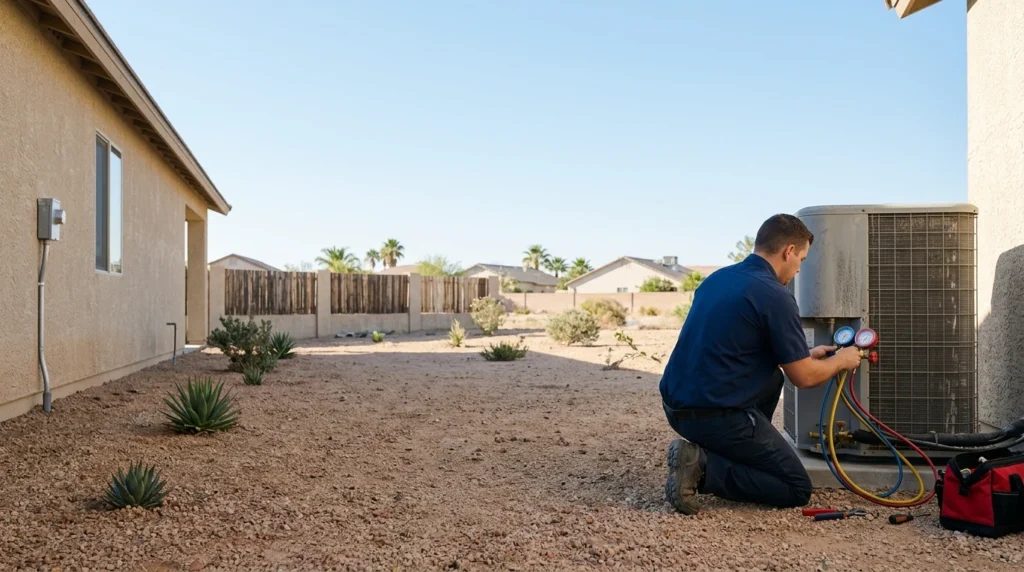
Air conditioning works by moving heat from inside your home to the outside. It does not make cold. A fluid called refrigerant absorbs heat from your indoor air at the indoor coil, then a compressor pumps it to the outdoor unit, where the heat is released into the outside air. The cooled, drier air is blown back through your ducts. The same refrigerant then loops back inside to pick up more heat.
This is called the vapor compression refrigeration cycle. Your refrigerator uses the same idea. Knowing how it works makes it much easier to understand why your AC acts the way it does in a Las Vegas summer.
What Are the Main Parts of a Central AC?
| Part | Location | Job |
|---|---|---|
| Thermostat | Inside wall | Tells the system when to run |
| Evaporator coil | Indoor, on the air handler or furnace | Absorbs heat from indoor air |
| Blower | Indoor air handler or furnace | Moves air across the coil and through ducts |
| Compressor | Outdoor unit | Pumps refrigerant and raises its pressure |
| Condenser coil | Outdoor unit | Releases heat outside |
| Condenser fan | Top of outdoor unit | Pulls air across the condenser coil |
| Expansion device | Near the indoor coil | Drops refrigerant pressure before the coil |
| Refrigerant lines | Between units | Carry refrigerant in a loop |
| Ducts | Attic, walls, floors | Deliver cooled air and return warm air |
How Does the Refrigeration Cycle Work, Step by Step?
- Evaporation. Cold, low pressure liquid refrigerant enters the indoor coil. Warm indoor air passes over it. The refrigerant absorbs heat and boils into a gas.
- Compression. The gas travels to the compressor outside, which squeezes it. Its pressure and temperature rise well above the outdoor air temperature.
- Condensation. The hot gas flows through the outdoor coil. The fan blows outdoor air across it. The refrigerant gives up its heat and turns back into a liquid.
- Expansion. The liquid passes through an expansion device, which drops its pressure and temperature. It returns to the indoor coil to repeat the cycle.
Why the outdoor air feels hot
The air blowing off the top of your outdoor unit is the heat that was inside your home, plus heat from the compressor.
Why Does an AC Make Water?
Cooling the air also dries it. When warm air hits the cold indoor coil, moisture condenses on it, like water on a cold glass. That water drips into a pan and drains outside. If the drain clogs, you get leaks. See why your AC is leaking water.
Why Does Desert Heat Make an AC Work Harder?
The outdoor coil has to release heat into very hot air. For heat to flow out, the refrigerant must be hotter than the outdoor air. On a 115 degree afternoon, the compressor has to push pressure and temperature higher than on an 85 degree day. That takes more power and puts more stress on parts.
What that means for you
- Capacitors and contactors fail more often in summer. See how to test an AC capacitor.
- A dirty outdoor coil hurts more here, because it already has a hard job.
- Long run times are normal on the hottest afternoons.
How Is a Heat Pump Different?
A heat pump runs the same cycle in both directions. A reversing valve flips the flow so the outdoor coil absorbs heat in winter and the indoor coil releases it. See what is a heat pump.
What Do the Efficiency Ratings Mean?
SEER2 and EER2 tell you how much cooling you get for the electricity used. The cycle is the same in every system, but better coils, compressors and fans move heat with less power. See what is SEER2.
What Is Refrigerant?
Refrigerant is a fluid chosen because it boils and condenses at useful temperatures and pressures. Older systems used R-22, which is no longer produced in the U.S. Many systems use R-410A, and newer systems use lower global warming potential refrigerants such as R-454B or R-32 under EPA rules. Only certified technicians can handle most refrigerants under EPA Section 608.
How Can You Help Your AC Work Better?
Help it move heat.
- Keep the filter clean so air reaches the indoor coil.
- Keep the outdoor coil clean so heat can leave.
- Keep vents open and returns clear.
- Seal leaky ducts.
- Book a yearly tune-up. See how often AC should be serviced.
The U.S. Department of Energy explains how central air conditioners circulate cool air through supply and return ducts.
A Typical Las Vegas Call: Why the Air Outside Feels Hot
An owner worried because hot air was blowing off the top of the outdoor unit. That is the heat removed from the house, plus heat from the compressor.
The system was working normally. Knowing how the cycle works helps you spot what is normal and what is not.
Need Help With Your AC in Las Vegas?
When one part of the cycle fails, the whole system stops cooling. Call and we connect you with independent local AC service providers who can find the weak link. Ask for the price first. See HVAC repair in Las Vegas, AC maintenance in Las Vegas and AC installation in Las Vegas. We take calls for every part of this cycle across the valley, including North Las Vegas. See AC repair in Las Vegas.
Frequently Asked Questions
How does an air conditioner cool a house?
It moves heat from inside to outside. Refrigerant absorbs heat at the indoor coil, carries it to the outdoor unit and releases it there.
Does an AC bring in outside air?
Most central home ACs recirculate indoor air. They do not bring in fresh outdoor air unless a ventilation system is added.
What does the compressor do?
The compressor pumps refrigerant and raises its pressure and temperature so it can release heat outside.
Why is hot air coming out of my outdoor AC unit?
That is normal. The hot air is the heat removed from your home, plus heat from the compressor.
Why does my AC produce water?
The cold indoor coil pulls moisture from the air, which drips into a pan and drains outside.
Does an AC use refrigerant up?
No. Refrigerant circulates in a sealed loop. If it is low, there is a leak that needs to be repaired.
Why does my AC work harder on very hot days?
It has to push heat into hotter outdoor air, so the compressor must raise refrigerant pressure and temperature higher. That takes more power.
What is the difference between an AC and a heat pump?
A heat pump uses the same cycle but can reverse it to heat the home in winter. An AC only cools.
Contact Emergency Repair Service
Call now. We connect you with independent local AC service providers anywhere in the Las Vegas valley.
AC & HEATING calls · LAS VEGAS VALLEY
AC Down? Get a Straight Answer Backed by Real Numbers.
Calls answered 24 hours · Independent local AC service providers · No contracts
Call or text
(725) 300-3660, answered 24 hours a day. Same-Day service across the valley.
Where we are
3863 S Valley View Blvd, Las Vegas, NV 89103. Serving the whole valley.